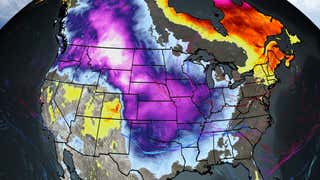
- A blast of arctic cold air is headed into the U.S. beginning late this week.
- It will penetrate into the South by this weekend, and could drop temps below freezing for several days.
- Some daily cold records will be in jeopardy.
- This generally colder pattern could hang on until the last full week of January or longer.
An arctic cold outbreak will deliver potentially record-setting, frigid air to much of the country, including the Deep South, into next week. Daily records for mid-January could be broken from Montana to the Gulf Coast.
(CURRENT MAP TRACKERS: Temperatures | Wind Chills)
When It Will Happen: We expect the outbreak to arrive in two rounds.
The first plunge of cold air will push southward, from the northern Rockies into the Northwest and Central Plains, from Thursday into Friday.
Following that, an even stronger cold blast will surge south, from the Northwest through the Southern Plains and Midwest this weekend, before working its way toward the Southeast early next week, and finally the East Coast by next Tuesday or Wednesday.
(Further beef up your forecast with our detailed, hour-by-hour breakdown for the next 8 days – only available on our Premium Pro experience.)
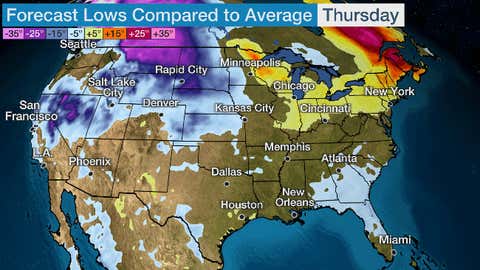
This animation shows how far below average low temperatures are forecast each day through Wednesday, Jan. 17. The brightest pink contours indicate where low temperatures are expected to be farthest below average for this time of year.
How Cold It Will Get: During the coldest days of the outbreak…
- Lows in the 20s will occur along the northern Gulf Coast, from East Texas to North Florida.
- Teens, perhaps even a few single digit-lows are expected in the Deep South.
- Below-zero low temperatures could occur as far south as parts of the Texas Panhandle, Oklahoma and northern Arkansas.
- Lows in the minus 20s are possible as far south as Iowa and Nebraska.
- Some lows in Montana could reach minus 40 degrees.
Daily records – coldest for the calendar day – are possible in Montana and Wyoming this weekend, then in parts of the Central and Southern Plains, particularly Monday and Tuesday.
Among the other notables, Chicago’s O’Hare Airport could plunge to the minus teens for the first time since the January 2019 cold outbreak. Oklahoma City could plunge below zero for the first time since the historic February 2021 cold outbreak. That said, we don’t expect this outbreak to match the ferocity of either January 2019 or February 2021.
(FORECAST DETAILS: 10-Day U.S. Highs and Lows)

Wind Chill Danger: Strong winds will also accompany each plunge of cold, arctic air. Those winds will combine with the cold to produce dangerous wind chills in the Rockies, Plains, Midwest, even in parts of the South.
Some wind chills in the Northern Plains could drop into the minus 40s, even minus 50s, at times, which could lead to frostbite on any exposed skin in as little as 10 minutes.

How Long It Will Last: In many of these areas, the coldest air will be either through this weekend or during the first half of MLK week. Parts of the South, including Oklahoma City, Dallas and Nashville, could see several days in a row with daytime highs below freezing.
However, a generally cold pattern is expected to linger in much of the U.S. from the Rockies eastward into the week of January 22.

A Bitter Cold NFL Playoff Game: As luck would have it, the warm weather Miami Dolphins will travel to Kansas City to face the defending Super Bowl Champion Chiefs in an AFC Wild Card playoff game Saturday. Oh, and it will also be a night game at Arrowhead Stadium.
For now, our forecast calls for temperatures in the single digits with lingering northwest winds plunging wind chills into the single digits or teens below zero.
This could eclipse the coldest game the Dolphins have ever played in, which also happened to be in Kansas City just over 15 years ago – a game the Dolphins won, by the way. According to CBSSports.com, the coldest home game in Chiefs history was on Dec. 18, 1983, with a kickoff temperature of 1 degree.

Snow covers the field before an AFC Divisional Round playoff game game between the Indianapolis Colts and Kansas City Chiefs on January 12, 2019 at Arrowhead Stadium in Kansas City, MO.
(Scott Winters/Icon Sportswire via Getty Images)
Why It’s So Cold: There are several reasons for this powerhouse cold outbreak.
First, blocking high pressure aloft near Greenland and the Canadian Arctic is forcing cold air out of Canada deep into the U.S., a common pattern for outbreaks in winter.
That cold air will be kept refrigerated by ample, widespread snowpack over the U.S. thanks to the recent siege of winter storms.
And this is all happening around what is typically the coldest time of winter.
This is a stunning reversal of a pattern that lead to America’s record warmest December in 129 years and the least Christmas snow cover in 20 years.

MORE ON WEATHER.COM
- How To Prevent Frozen Pipes In Your Home
- Tips For Staying Warm When The Power Is Out
- How To Protect Yourself From Hypothermia
Jonathan Erdman is a senior meteorologist at weather.com and has been covering national and international weather since 1996. His lifelong love of meteorology began with a close encounter with a tornado as a child in Wisconsin. He studied physics at the University of Wisconsin-Madison, then completed his Master’s degree working with dual-polarization radar and lightning data at Colorado State University. Extreme and bizarre weather are his favorite topics. Reach out to him on X (formerly Twitter), Threads, Facebook and Bluesky.
The Weather Company’s primary journalistic mission is to report on breaking weather news, the environment and the importance of science to our lives. This story does not necessarily represent the position of our parent company, IBM.